

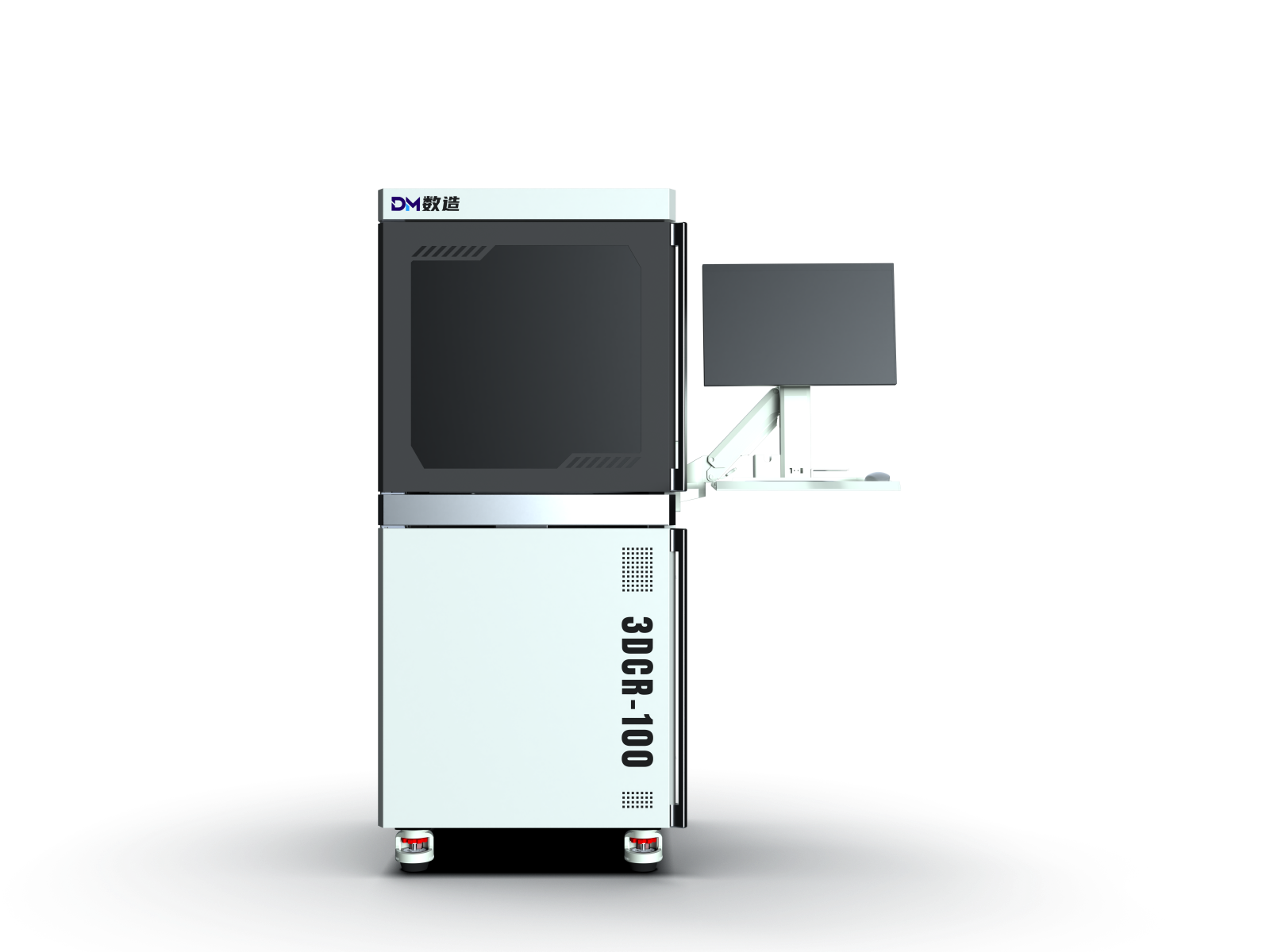
Start testing with just 500g of material! The 3DCR-100 SLA 3D printer is the ultimate tool for materials R&D.
Material R&D Pain Point: One test comes at a high cost.
Anyone in photopolymer R&D knows: traditional equipment requires kilograms of material just to run a single test. Before your formula is even validated, raw material costs skyrocket. Worse yet, changing materials means cleaning the vat, flushing lines, and recalibrating—often leaving you with only a few formulas tested per day. Your R&D pace is dictated by the equipment, not your progress.
Is there a single device that lets R&D teams work with the freedom of an experiment—taking small samples, testing quickly, and switching flexibly?
3DCR-100 was created to solve this problem.
3DCR-100: Compact SLA 3D printer designed for materials R&D
It features a piston-based molding chamber, paired with a high-precision laser scanning system and intelligent print control algorithms. Maximum build volume is 100×100×100 mm, and printing can start with just 200 ml of material.
Key Parameters Overview
Maximum Build Size | 100x100x100mm |
|---|---|
Molding Process | SLA photopolymerization |
Starting Material Quantity | 200mL |
Optional light source | 405nm |
Maximum Part Weight | 1 KG |
Why is it considered a "power tool" for materials R&D?
Material-efficient.Piston-based molding cylinder design: material usage depends on sample height—1 kg of material can print a 6 mm high test specimen. Testing can begin with as little as 500 g, which drastically reduces material cost per iteration during formulation exploration and small-batch trials.
Switch fast.The quick-change design enables R&D teams to test multiple material formulations in a single day, delivering true "multiple formulas per day" iteration speed. For teams prioritizing material diversity, this is a tangible efficiency multiplier.
Compatible with a wide range of materials.Whether low-viscosity resin or high-viscosity paste, direct machine testing is supported. Even non-flowing pastes can be printed using manual dispensing mode for verification—no material restrictions.
Dual wavelength coverage.Equipped with a standard 355nm laser light source to meet R&D needs for mainstream photopolymer resin systems. For testing materials in the 405nm wavelength band, a DLP light source module can be added as an option, enabling one device to cover both major curing wavelengths.
Who needs this device?
R&D enterprise for photopolymer resin materials、Ceramic Slurry Formula Development Team、3D Printing Materials Laboratory for Universities and Research Institutes,And need to quickly filter recipes、Materials innovation team that reduces trial-and-error costs。
Final Thoughts
The core competitive advantage of material R&D is iteration speed. 3DCR-100 leverages "Compact, material-efficient, and highly flexibleOur product logic minimizes the barrier for every formula validation. While others wait for tank cleaning, you're already running the next formula.Fewer resources, more recipes, faster results—that's the power of 3DCR-100.